
A post about what allows younger and younger players to succeed in chess. Big time.
“Nowadays, when you’re not a grandmaster at 14, you can forget about it” ~Vishy Anand
Light comes from within!
The boy you see in the head picture is Tamizh Amudhan, an 8 year-old from Sivakasi, India. Recently the power went out at his home during a Freestyle Friday event, but that didn’t stop him from outplaying and beating Vincent Keymer, currently ranked 7th in the world. And this was not an accidental mouse-slip or a blunder by Vincent. This was a close double-edged battle, which could have gone either way:
https://lichess.org/study/e7eSTPk5/Xl0qYOai#0
Vincent got a winning advantage out of the opening, as could be expected due to a vastly deeper understanding of the game. But I hear this refrain so often from students these days; this kid didn’t understand chess at all yet he/she still beat me! There might be an inkling of truth to this, but the fact that it happens so often shows there’s more at play here. Many kids from these new strong generations have skill-sets which compensate for their lack of knowledge and understanding. In this case, a tactical skirmish allowed Tamizh to break through Vincent’s center, and put his own into action. This shows great resilience, as I remember kids from the pre-covid era resigning or mentally resigning against me when their position was clearly worse. Once Tamizh got the type of attacking position he wanted, the ferocious onslaught was unstoppable. You know that he’s practiced these attacks many many times in his young life.
It’s also interesting that Vincent himself was a former child prodigy, being spotted by Peter Leko when he was 13. I guess prodigies losing to newer protegies is the natural cycle of life, although these days the cycle seems to be speeding up! Today I’d like to show what allows these young child/teen prodigies to not only pose a challenge to the best but become the best. Among many examples of such Wunderkings and Wunderqueens, I’ll focus on 3: Javokhir Sindarov, Yağız Kaan Erdoğmuş, and Vaishali Rameshbabu. Here is what makes them stand out:
Javokhir Sindarov:
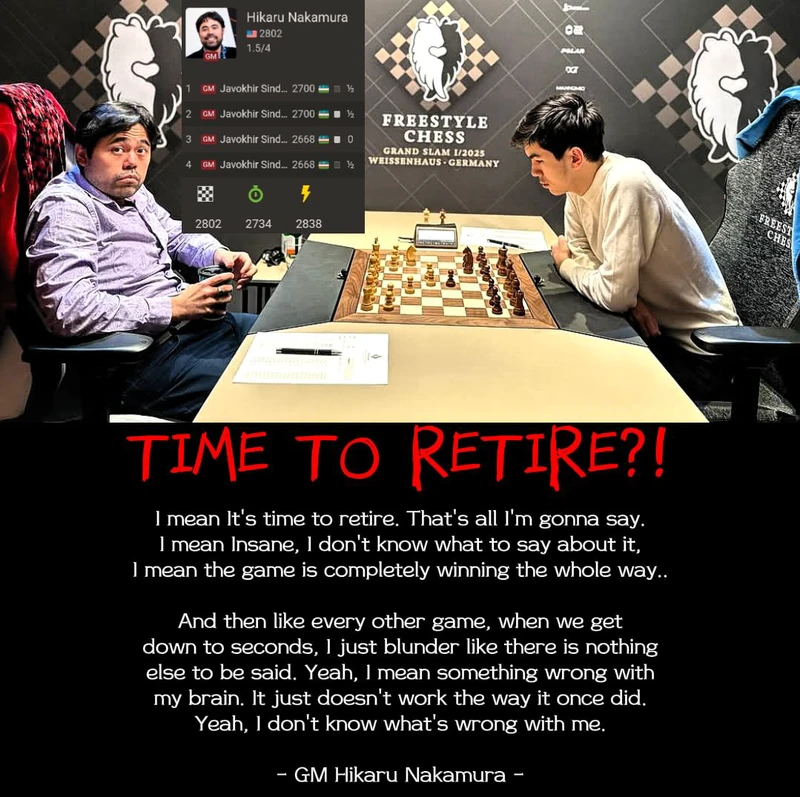
The upcoming world championship will hold the record for the youngest age average 20 year-old Sindarov vs. the 19 year old Gukesh. One thing that elevated Sindarov to the world championship match is his exceptional time management.
https://lichess.org/study/e7eSTPk5/1C8bFyBK#0
Take a look at the time stamps for Sindarov vs Caruana at the different points of the game. Yes, Sindarov was clearly better prepared and guessed the game line perfectly. That being said, let’s start with move 13 where the time situation is 1:54 vs 1:27. Caruana spends a luxurious 18 minutes on 13…Nb3 just to be met with fairly instant c6 and Nd4. Perhaps this was still Sindarov’s prep, or perhaps he was figuring out the details on his opponent’s time? Regardless, the time difference had now risen to 1:52 to 51. At this point, Sindarov wisely started to take his time, as the more intuitive 17.f3 is less precise than 17.g3 which he played. Quite often in the Candidates, he had an uncanny sense of when to stop and use the time advantage which he built up in each opening. Spending his time advantage wisely led to time bullying at the end of his games. When Caruana desperately needed the time to defend on move 24 onward, he had 5 minutes to 55. Sindarov’s moves were so intuitive and easy to play, that Caruana couldn’t even use his opponent’s time.
 Photo credit to Maria Emelianova
Similar time bullying took place two rounds later, in Sindarov’s game vs Wei Yi:
<iframe width=”600″ height=”371″ src=”https://lichess.org/study/embed/e7eSTPk5/p0Xwutvm#34″ frameborder=0></iframe>
After a “brave” 46 minute think on move 18, Wei Yi only had 6 minutes remaining for move 30-40. Sindarov’s moves after this time tanking were not always the best, but they were all confidently played in 2-6 minutes. This clock weaponization led to Wei Yi self-destructing with 30. Rxd6 in an unpleasant yet equal position. Most strong kids of today (Sindarov being no exception) grew up on countless hours of blitz and bullet. Those who were able to use this training method effectively rather than procrastination became excellent time managers. They don’t second-guess their moves and learn to listen to their instincts.
Embracing complications
Most young stars of today feel comfortable in complex positions, like fish in water. Their amazing calculation allows them not to fear blunders, and play a lot like the engines they learn from:
<iframe width=”600″ height=”371″ src=”https://lichess.org/study/embed/e7eSTPk5/YXHQHB7t#0″ frameborder=0></iframe>
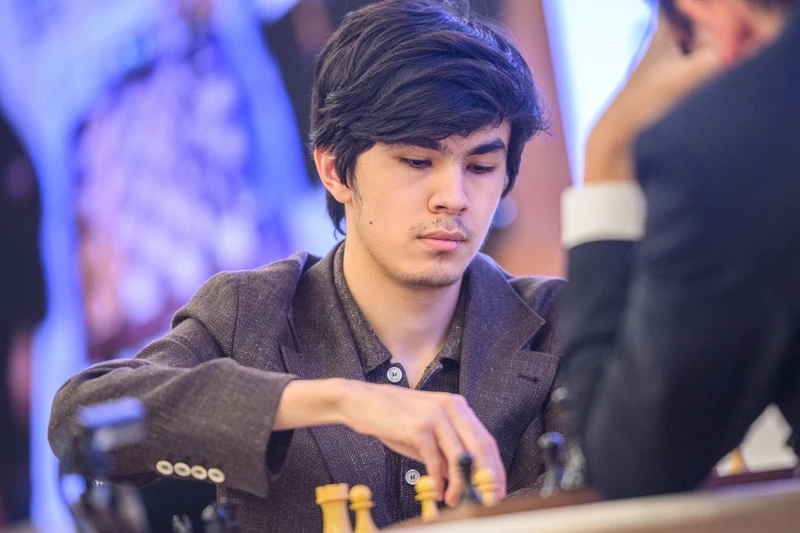
This was played by a 17 year-old Sindarov. If you looked at the opening and are wondering what the heck is going on, you’re in good company. By move 19, white technically has an extra point with an exchange+3 pawns for the rook. On top of that the bishop on a7 is locked out. Yet the problem for white is that their pawns can be blockaded, and black will seize the e-file soon. White’s pieces aren’t ready for battle and will be lagging. In terms of calculation, this was a clear case of one player out-calculating the other; MVL saw a tempting position with a Queen on h7 from far away, but must have missed 26…Rxa6 which stops white’s attack on the spot. MVL is no calculation-slouch either, which shows that kids like Sindarov weren’t scared of tactical battles against the best in the world. My theory is that growing up with online blitz and Titled Tuesdays, talented kids were able to play many games against 2700+ Grandmasters, which let them avoid psychological complexes and trusting their opponents’ calculation.
Acute Board Awareness
I remember listening to Peter Svidler discussing what makes the new generations stand out, especially when competing with people born in the 20th century. He claimed that the top kids practically never blunder, always feeling when something’s hanging or when something’s threatened, even if subconsciously. This even applies to faster time controls, where they see these threats quicker than the generations before them. Blunders at the top have always been rare but relatively-speaking, this improved according to Svidler.
Perhaps as a consequence of the million tactical-training tools online, the kids’ board awareness extends to tactics too. Even at the 2000 level, they don’t miss forcing sequences which net material. Not to mention someone like Sindarov. Black to play and not lose!
<iframe width=”600″ height=”371″ src=”https://lichess.org/study/embed/e7eSTPk5/cKJQkIeu#41″ frameborder=0></iframe>
This is a nice example of the older generation having a momentary lapse in board vision, which Sindarov duly punishes. The prudent 21…f6 keeps everything intact, with an equal position.
Yağız Kaan Erdoğmuş
Erdogmus is a Turkish chess prodigy who recently became the youngest player (at 14) to reach 2700 Fide. Here is what stands out in his games:
No fear of ghosts
<iframe width=”600″ height=”371″ src=”https://lichess.org/study/embed/e7eSTPk5/zJj1nQMN#42″ frameborder=0></iframe>
In the current Swedish super-tournament taking place right now, Erdogmus faced Nils Grandelius and another tactical slugfest ensued. Notice that around move 17, neither side shies away from complications. Instead of the 17.e5 fireworks, Erdogmus can just as easily play 17.Nbd2, which is just as good if not better. This aggressive drive towards chaos is rewarded only if you don’t fear walking a tight-rope. Going for 22. Nxd7 requires seeing the consequences of both Bxf2 and Rxf2 which both look intimidating. After Rxf2, there are mating ideas with …Rf5-Rh5. The discovery itself looks vicious. Yet the top kids learn to avoid emotional calculation in favour of cold-blooded concreteness. The only ghosts they believe in are the ones that can be proven with lines.

Creativity
When I started watching Erdogmus’ games, I was skeptical at first. Partially because of the rumours that the matches he played were orchestrated to get him to 2700, partially because it was hard to believe how anyone can get to 2700 at such an age. Growing up, it was a form of implied wisdom that to get to GM/Super GM level, one has to accumulate thousands and thousands of patterns, go over thousands and thousands of games from the past, gradually develop a repertoire (another thing of the past), and accumulate enough losses in that repertoire to have structural experience. Yet going over Erdogmus’ best games, it feels like these factors aren’t needed. His openings are all over the place, beating Topalov in the Caro, Svidler in the French, and playing whatever seems to work for him. As for experience and other factors, they’re replaced with calculation and great creativity:
<iframe width=”600″ height=”371″ src=”https://lichess.org/study/embed/e7eSTPk5/dMRQTayB#0″ frameborder=0></iframe>
The focus on the g2 square, eating away at the light square colour complex, is something else. I don’t remember many games where g2 was used as a transit square by both the black bishop and knight…The mating combination with 37…Qxf2 feels set up from a mile away, and would have to be foreseen while playing 34…Re5. This feels like something Tal would be proud of, except it was also sound! Of course it was by no means perfect, as 31…Re1 would be a lot more efficient, but perfection and creativity often don’t like each other!
 Not sure who’s scarier, this guy or the terminator 🙂
Principled Play
Earlier this year, I watched a video of Erdogmus facing the lower-rated Abugenda in the first round of the World Cup. You’d think a teenager would need some time to get used to this event caliber, perhaps start off solidly and cautiously before catching his rhythm. You’d be dead wrong, as he went on to demolish his opponent in 17 moves with black. He saw the premature attack white had in mind, raised an eyebrow, and followed the old adage that an attack on the side must be met with an attack in the center, even at the cost of a knight. As you see, creativity isn’t at odds with principled play, it should start with principled play:
<iframe width=”600″ height=”371″ src=”https://lichess.org/study/embed/e7eSTPk5/rEwZlHjy#13″ frameborder=0></iframe>
Fast forward to May 2nd, where Erdogmus was facing Zhu Jiner. He had to deal with the unusual move order of 1.Nf3, 2.e3, 3.b3, probably meant to get him out of his comfort zone.
<iframe width=”600″ height=”371″ src=”https://lichess.org/study/embed/e7eSTPk5/i8p5RbWV#20″ frameborder=0></iframe>
Once again, he showed no fear at white’s early aggression on the kingside, understanding that moves like 11.g4? shouldn’t work in chess.
The antidote was swift and brutal, focusing strictly on the center. The g-file and the bishop pair didn’t scare him, as he showed that the white king still proves weaker than his black counterpart. He played the middlegame in a very classical manner, conquering the outpost on f4, infiltrating the dark squares, and dominating the bishop on f1. There was no hint of the attack that Zhu must have wanted. If I didn’t know the age of the players, I would have assumed that black was much much older! This striving towards principled play gives him the base to outplay strong GMs who may be more loose and prone to experiments.
 Credit to Michal Maluszha
P.S. At the time of this writing, Erdogmus failed to hold off Magnus in a crucial last-round drawn endgame, showing that there are still aspects of his game to improve. At least he learned what positions to avoid against Magnus! The fact that he got this drawn endgame to begin with shows that he’s on track for the top player tournament circuit, if he can handle the pressure and work on his mistakes/mindset.
Vaishali Rameshbabu
Defensive tenacity
To be honest, until this Candidates Tourney, I didn’t follow Vaishali’s games much. Perhaps being in her brother’s shadow has made her less famous than she deserves to be, as the Candidates have shown. Looking at her games now, it’s possible to see a typical progression of an aggressive player learning to combine offence with defence over time. It’s clear from her opening choices that she prefers sharp positions where she’s attacking, but when she needs to defend, she can calculate her way out of trouble and stay “solid enough”:
<iframe width=”600″ height=”371″ src=”https://lichess.org/study/embed/e7eSTPk5/omkmH0iR#35″ frameborder=0></iframe>
White is clearly to be preferred, and black’s queenside counterplay is slow, their pieces more passive. Yet Vaishali makes sure that there’s no direct path of attack with 18…f5 and 23…Kf7! Which makes Nodirbek go for a positionally berserk queen sac. After her queen becomes dominant, she has no trouble cleaning up despite any rating difference.
But the best example is her game against Kateryna Lagno in the last round, where any enemy tricks from a tricky/resourceful attacker were seen and kept away at a safe distance:
<iframe width=”600″ height=”371″ src=”https://lichess.org/study/embed/e7eSTPk5/DxREUcI1#0″ frameborder=0></iframe>
Despite playing into a Dragon, Vaishali doesn’t mind stealing a pawn and staying solid, claiming insufficient compensation. Lots of players would have panicked seeing that open a-file or not had the patience to nurse the extra pawn to health. By staying centralized and distracting black from their attack, Vaishali made sure she was never in trouble.
Good feel for dynamics
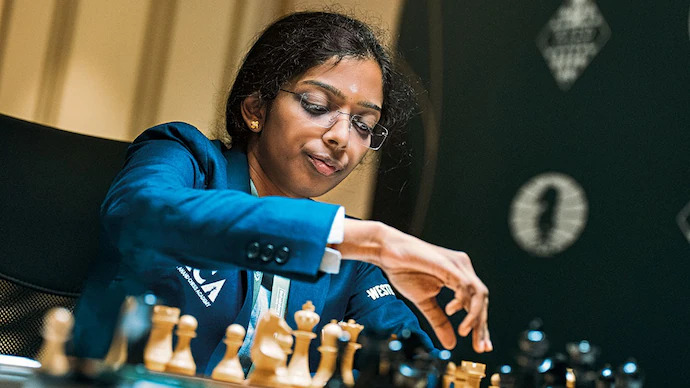
All 3 of our wunderkinds embrace complications with open arms, which helps develop a barometer for the dynamic balance. Knowing how much pressure can be applied on what side, knowing who’s faster to their target, and finally feeling how urgent the position is really helps stay afloat in dangerous waters:
A lesser player might have gotten scared by the c-file opening up and thought that this resembles a decent French structure for black, with the French bishop gone. However, the knight on b6 is the new French bishop, having no prospects and getting in the way. White’s attack turns out to have more bite than black’s, even if the kingside seems solid for the moment. The attacking conversion wasn’t perfect, but the 41.Rxf8 exchange sac was a sign of dynamic mastery. Black is condemned to an eternity of passive defending, where the position might be equal but white is always attacking. No wonder Goryachkina cracked in the endgame.
Vast theoretical foundation
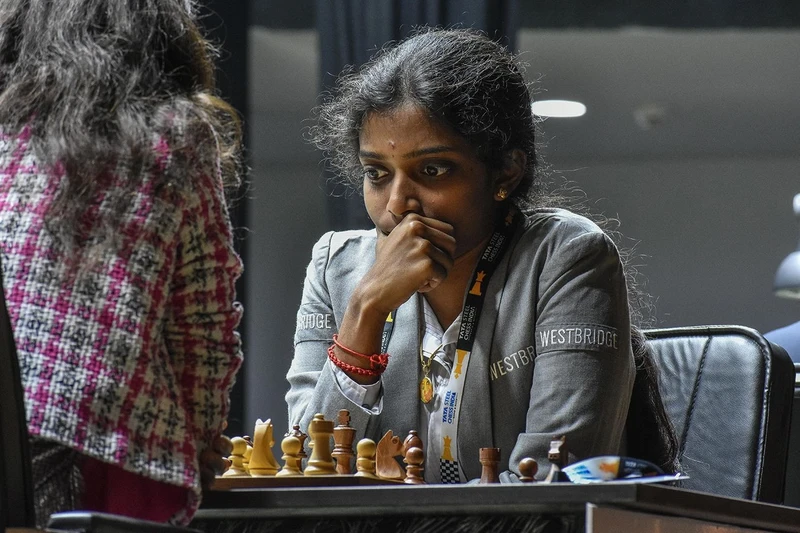
Vaishali’s opening prep is both deep and wide, meaning she can play many lines but also know them fairly well. The Dragon game versus Lagno was an example of that, as 11.Bc4 is all the rage these days. She doesn’t mind solid structures common in the Giucco Piano (her brother is an expert), but also tries spicier setups when needed, like the Benoni, French, and the Gruenfeld. She plays both 1.e4 and 1.d4 as white, having tried both the Catalan and the Torre attack. The only similarity I found between all 3 of our youngsters is that they rarely repeat lines. For example, against the Caro-Cann she has tried the Advanced Short Variation, Exchange Variation, Classical Tartakower, and the Two Knights Attack. In the Candidates, instead of going for any of the above lines against Zhu Jiner, she went for this:
<iframe width=”600″ height=”371″ src=”https://lichess.org/study/embed/e7eSTPk5/9Lys9PVy#0″ frameborder=0></iframe>
This almost worked as Zhu Jiner went for a non-critical response and ended up squeezed on the kingside. While this wasn’t enough to win, it shows that the younger generation is actively testing new ways of getting advantages along with new philosophies towards the opening. While the older generations (Dubov, Nakamura, Carlsen) are talking about how hard it is to get a game in classical, the young generations keep analyzing new ideas and new ways to play those old openings (apparently they still exist!).
What this means for the future of chess
The theoretical physicist Max Planck wrote that new scientific ideas don’t get accepted by persuasion, they replace old ideas that die with their creators. As a new generation grows up watching the games of Sindarov rather than Carlsen, and Vaishali rather than Hou Yifan, we will see kids with all the qualities that I mentioned above, the winning qualities of today. So next time you lose against kids, don’t despair. Learn to beat them at their own game 🙂
I hope you enjoyed this post.
If you like your kid to be the next Sindarov, Vaishali, or just a chess-loving player, I run the biggest school in North America for kids and teenagers.
If you’re interested, you can find more details and arrange a free trial class here and do a level assessment here.
Also, you can check out my book on chess stories, which you can find here.
It’s a collection of short stories about the lives of chess champions; their quirks, battles, embarrassing moments, and strokes of luck.
Cheers!
