CCYC 2026 Spring Term :
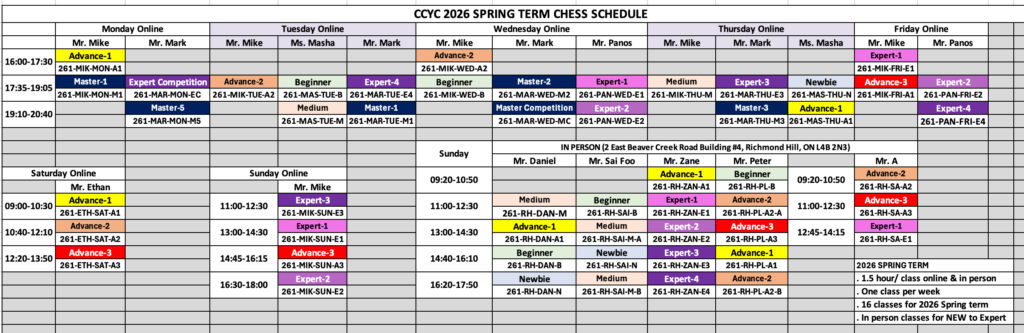
- Will have both in person and online classes for 2026 Spring term, which will all begin from Jan;
- For in person classes, the location will be: 2 East Beaver Creek Road Building #4, Richmond Hill, ON L4B 2N3;
- For online classes, please download zoom app before the first class; Also need to register one lichess.org account before the classes;
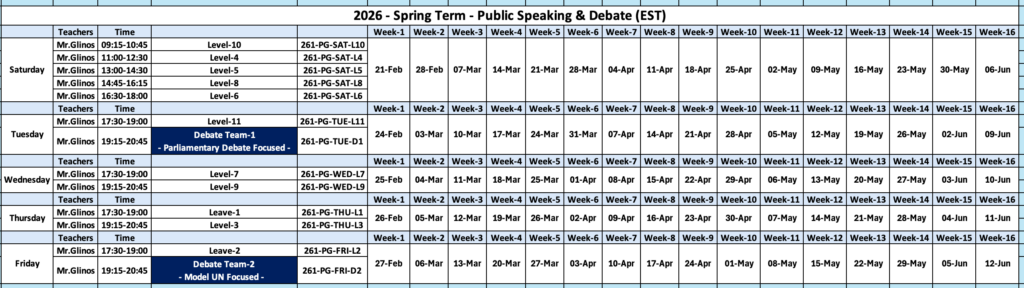
- For debate classes, all will be online classes for spring term 2026;
- US Eastern Time
2026 Spring Term Introduction :
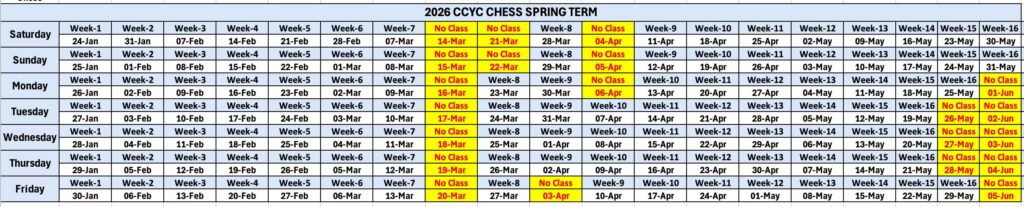
2026 Chess Spring term is from Jan-24, 2026 to May-31, 2026. There are 16 weeks, 1 class per week for each group; 90 minutes per class, including lectures and practices; Students could use online self-assess tools to decide their level or contact customer service to arrange assessment during school time;
Self-assessment: https://client.canadachess.ca/
CCYC has the right to change the coach before or during the term; CCYC has the right to combine or cancel some classes if less than 6 students registered before term starts.
Registration :
Registration :
- One student will be registrated by one order; if you want to register multiple students, you have to submit separately. It’s required to fill out the information of the student before checking out. If you don’t have WeChat account, just say ‘no wechat’;
- You can use the filter function, such as CLASSTYPE, LEVEL, TEACHER and TIME to quickly find the suitable course. Or you can also use SEARCH to put in key words for a quick search.
- Please turn your Phone/iPad sideways for registration 如果你使用手机,或者PAD操作,为获得最好的效果,请把屏幕横过来操作。
Exchange class:
Exchange class:
- We have 16 classes this term. Every student has two free chances to make up a missing class. Please contact with customer service (ccycservice@gmail.com or WeChat: ELSA_CHESS) at least 24 hours before the missing class. No refund for missing classes. CCYC has the right to cancel classes due to website issues or irresistible forces. Parents can apply to make up those canceled classes online. No refund. Email: ccycservice@gmail.com
CCYC Refund Policy (2026 Spring Term):
CCYC Refund Policy (2026 Spring Term):
If you would like to withdraw from a course, please submit written notice to ccycservice@gmail.com no later than Jan 10th, 2025 to be eligible for a refund (less a 15% administration fee). No refund will be made for cancellations received after Jan 10th, 2025 for Spring Term.
Some exceptions to this policy apply:
-CCYC is sometimes forced to cancel courses due to insufficient enrolment or other reasons. If this occurs, a full refund will be processed.
-CCYC understands potential unexpected family problems/changes. If this occurs, please talk to us and we will work out a plan together.
For any questions, please contact us at ccycservice@gmail.com
Others:
You can check the status of your orders in “My Account”. You will receive email notice when the status of the order changes to COMPLETE. You can receive the Invoice by email and you can also download the PDF invoice in your email.
2026 Spring Term Fee
2026 Spring Term Fee
-
Early bird 539 plus hst before Jan-6th Full price 609 plus hst after Jan-6th
Master Competition Classes Introduction
Master Competition Classes Introduction
Master Competition-Maneuvering
Expert Competition-Double Edged Positions
Master Competition: 16-Week Course; Instructor: International Master Mark Plotkin
Introduction: The Art of Maneuvering
In chess, not every position is decided by tactics or direct attacks. Many of the most important battles are won through maneuvering. Maneuvering is the skill of improving your pieces, restricting your opponent’s options, and slowly increasing the pressure.
Strong players ask deeper questions:
Which of my pieces is worst placed?
Where should this piece ideally go, even if it takes several moves?
Which squares does my opponent want, and how can I take them away?
In this semester, we will study how top players handle seemingly “quiet” positions. You’ll learn how to:
Reposition pieces efficiently over multiple moves
Recognize good and bad plans in all types of structures
Use maneuvering to provoke weaknesses and create long-term advantages
Maneuvering is what separates players who react from players who control the game.
Introduction: Playing Double-Edged Positions
Not all chess positions are meant to be “safe.” Some positions contain advantages for both sides. Imbalances where one mistake can immediately decide the game. These are known as double-edged positions, and learning to handle them is essential for players who want to win consistently against strong players.
In double-edged positions, general principles are not enough. You must constantly evaluate:
Whose attack is faster?
Which weaknesses actually matter?
When to calculate deeply and when to trust strategic judgment
When simplifying helps you, and when it helps your opponent
In this semester, we will explore positions where both players have chances, but only one will seize the initiative. You’ll learn how to:
Identify critical moments where the game can swing in either direction
Balance risk and calculation under pressure
Convert dynamic advantages without overextending
Defend actively while maintaining counterplay
Strong players don’t avoid double-edged positions they understand them. Mastering these positions will sharpen your decision-making, improve your practical results, and help you remain confident when the game becomes sharp, unbalanced, and unpredictable.
Debate Team Introduction
Image Classtype Level Teacher Time Price Buy hf:att:pa_classtype hf:att:pa_level hf:att:pa_teacher